pylab_ml.smu.keithley.keithley2400.Keithley2400
- class Keithley2400(addr=None, interface=None, backend=None, identify=True, instName=None)[source]
Bases:
KeithleyInterface to the Power-Measuremet-Unit (SMU) Keithley2400.
- Date:
September 18, 2026
- Author:
Semi-ATE <info@Semi-ATE.org>
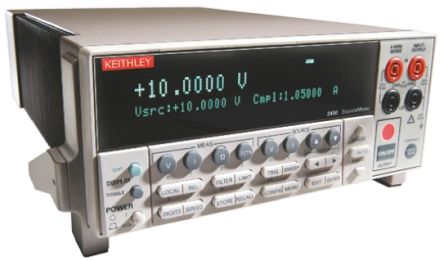
The Keithley2400 can source and sink power in all four voltage/current quadrants and measure voltage and current precisely
- __init__(addr=None, interface=None, backend=None, identify=True, instName=None)[source]
Connect and initialize Keithley2400 instrument.
- Parameters:
addr (int) – Interface address
interface (Interface) – GPIB, USBSerial
backend (str) – VISA backend is either ‘@ni’ for NI-Library or ‘@py’ for pure python pyvisa-py backend. On default it uses ‘@ni’ on win32 and ‘@py’ on other platforms.
identify (bool) – If True, query the instrument ID and print it to the log.
instName (string) – Instance Name from parent.
- Example: Initialization
>>> vdd = Keithley2400(addr=24)  # GPIB or USB address
>>>                              #  validate displayed message Id on device
>>> vdd.init()                   # connect and initialize instrument
- Example: Voltage source
>>> vdd.i_clamp = 0.01           # current protection
>>> vdd.voltage = 3.3            # set output voltage
>>> i = vdd.current              # measure (supply) current
- Example: Current source
>>> vdd.v_clamp = 5              # voltage protection
>>> vdd.current = 0.1            # set output current_range
>>> v = vdd.voltage              # measure voltage
Methods
__init__([addr, interface, backend, ...])Connect and initialize Keithley2400 instrument.
clear()Clear error status.
close([force])Close connection to instrument.
com_recover([fix])Detect & attempt to recover out of step communication (maybe after timeout).
List of instrument errors.
find_names() returns list of identifiers strings, lhs of = assignments
get_values([typ])Transfer last requested measurement sweep results.
help()Print the docstring of the instrument class.
identify([showInstName])Identify message.
init([identify])Connect to Keithley instrument and initialize.
local()Switch back to local instrument control.
message([message])Message display about Keithley instrument.
mfilter(input)mqtt_add(client, instrument[, liste, qos])Add the instrument to mqtt.
Remove the instrument from mqtt.
off()Deactivate outputs.
on()Reactivate outputs.
publish(topic, value)Publish topic as type='cmd' with payload=value.
publish_get(function_name, value)Publish function_name as type='get' with paylad=value.
publish_set(function_name, value)Publish function_name as type='set' with paylad=value.
reset()Reset and switch beep off.
Start setup instrument settings, called from class instruments.
stair_sweep(start, stop, dstep[, stime, ...])Sweep V or I, measure v,i,r at time t with state s, change by dstep, steptime stime, wait for response.
Attributes
Autorange drive current on or off.
Set the current drive range (A).
Autorange drive voltage on or off.
Set the voltage drive range (V).
Get driver Voltage.
Set/get channel number if the instrument have more than one channel.
commandGet or set output current.
Autorange current measurement on or off.
Set the current clamping (A), will adjust current measurement range.
Set the current measurement range (A), will adjust current clamping.
Query IDN.
Return with instname or instname[ch] if it has channels.
interchoicesGet or set measure.
Set/get the number of measurement to be carried out in a loop.
mqtt_enablemqtt_listGetter for the mqtt_status.
Set the conversion number of power line cycles accuracy, for all converters.
Set/get on state (True).
Get or set output function (VOLT or CURR).
Set incremental ramp to target or (target,slopetime).
Set incremental ramp to target or (target,dstep) or (target,dstep,stime).
Autorange voltage measurement on or off.
Set the voltage clamping (V), will adjust voltage measurement range.
Set the voltage protection limit|default|min|max, get 4 value tuple.
Set the voltage measurement range, will adjust voltage clamping.
Get or set output voltage.
- property I_autorange
Autorange drive current on or off.
- property I_range
Set the current drive range (A).
- property V_autorange
Autorange drive voltage on or off.
- property V_range
Set the voltage drive range (V).
- property Voltage
Get driver Voltage.
- Returns:
value(float)
- Return type:
driver Voltage (in V).
- property channel
Set/get channel number if the instrument have more than one channel.
- One can also use:
>>> vdd[0].voltage = 5           # set voltage from channel 0
>>> vdd[1].current = 0.1         # set current from channel 1
>>> v = vdd[1].voltage           # measure voltage from channel 1
- clear()
Clear error status.
- close(force=False)
Close connection to instrument.
- com_recover(fix=False)
Detect & attempt to recover out of step communication (maybe after timeout).
Can lose coherency between read request and data, usually because of Timeout this routine can diagnose such loss of coherency and attempt to fix it, when fix=True
- Parameters:
fix (bool) – If True, attempt to fix out of step communication by consuming extra data from the instrument.
- Returns:
True if communication is coherent, False otherwise.
- Return type:
bool
- property current
Get or set output current. If the current is set the output is switched on immediately.
- Returns:
value(float)
- Return type:
output current (in A).
- error_list()
List of instrument errors.
- find_names()
find_names() returns list of identifiers strings, lhs of = assignments
- Returns:
obj_names – List of identifier strings
- Return type:
list of str
- get_values(typ='')[source]
Transfer last requested measurement sweep results. Get response of previous stair_sweep(), choosing result rows from previous request typ.
- Parameters:
typ (str) – String with “vir” flags (VOLTAGE,CURRENT,RESISTANCE) defining the measurements to be returned. For example, “v” for voltage, “i” for current, “r” for resistance, “vi” for voltage and current, etc.
- Returns:
Numpy array of measured values corresponding to the “vir” flags in typ, with shape (len(typ), number of steps). For example, if typ is “vi”, the returned array will have two rows: the first row for voltage measurements and the second row for current measurements, with columns corresponding to each step in the previous stair_sweep().
- Return type:
np.array
- help()
Print the docstring of the instrument class.
- property i_autorange
Autorange current measurement on or off.
- property i_clamp
Set the current clamping (A), will adjust current measurement range.
- property i_range
Set the current measurement range (A), will adjust current clamping.
- property id
Query IDN.
- identify(showInstName=False)
Identify message.
- init(identify=False)
Connect to Keithley instrument and initialize.
- Parameters:
identify (bool) – If True, query the instrument ID and print it to the log.
- property instName
Return with instname or instname[ch] if it has channels.
- json = <module 'json' from '/home/runner/miniconda3/envs/test/lib/python3.9/json/__init__.py'>
- local()
Switch back to local instrument control.
- property measure
Get or set measure. Where the measurements are defined by “vir” flags (VOLTAGE,CURRENT,RESISTANCE)
eg. “v” for voltage, “i” for current, “r” for resistance, “vi” for voltage and current, etc.
- Parameters:
typ (str) –
- String with “vir” flags (VOLTAGE,CURRENT,RESISTANCE) defining the measurements to be made.
For example, “v” for voltage, “i” for current, “r” for resistance, “vi” for voltage and current, etc.
- Returns:
List of measured values corresponding to the “vir” flags.
- Return type:
list
- property measurecnt
Set/get the number of measurement to be carried out in a loop.
TODO: this function is not running yet, it is only a dummy
if the result == None than this function not implemented. The return value for the measurement is calculated togetheer with the mfilter setting.
- message(message=None)
Message display about Keithley instrument. Instrument message (“string”) or ()
If message is None, the display is cleared, otherwise the message is shown on the display.
- Parameters:
message (str or None) – Message to be displayed on the instrument. If None, the display is cleared.
- mqtt_add(client, instrument, liste='#', qos=0)
Add the instrument to mqtt. Calling from base_instrument, after the instrument (device) has been create. Normally you have not to use this function, only base_instrument use it.
- Parameters:
client (mqtt_init) – The MQTT client instance to which the instrument should be added.
instrument (object) – The instrument to be added to the MQTT client.
liste (list or str) – A list of attributes for which MQTT messages should be sent. If set to “#”, all attributes will be included (default: “#”).
qos (int) – The Quality of Service level for MQTT messages (default: 0).
- Return type:
None
- mqtt_disconnect()
Remove the instrument from mqtt. Calling from base_instrument, if the instrument are closing. Normally you have not to use this function, only base_instrument use it.
- property mqtt_status
Getter for the mqtt_status.
- property nplc
Set the conversion number of power line cycles accuracy, for all converters. For a plc of 1.0, conversion rate is 1/50s = 20ms. Accuracy max 10, min 0.01.
- Returns:
value(float)
- Return type:
number of power line cycles for conversion.
- property onoff
Set/get on state (True).
- property output_function
Get or set output function (VOLT or CURR).
- publish(topic, value)
Publish topic as type=’cmd’ with payload=value.
- Parameters:
topic (str) – The name of the topic to publish.
value (any) – The value to be published.
- Return type:
None
- publish_get(function_name, value)
Publish function_name as type=’get’ with paylad=value.
- Parameters:
function_name (str) – The name of the function to be published as a ‘get’ command.
value (any) – The value to be published as the payload of the ‘get’ command.
- Return type:
None
- publish_set(function_name, value)
Publish function_name as type=’set’ with paylad=value.
- Parameters:
function_name (str) – The name of the function to be published as a ‘set’ command.
value (any) – The value to be published as the payload of the ‘set’ command.
- Return type:
None
- reset()
Reset and switch beep off.
- property stair_slope
Set incremental ramp to target or (target,slopetime).
Stair_slope to target or target,slope_time using previous stair_sweep() parameters.
- property stair_step
Set incremental ramp to target or (target,dstep) or (target,dstep,stime).
Stair_step to target or target,dstep or target,dstep,stime, using previous stair_sweep() parameters.
- stair_sweep(start, stop, dstep, stime=0, typ='V', stair='Lin', wait=False)[source]
Sweep V or I, measure v,i,r at time t with state s, change by dstep, steptime stime, wait for response. If dstep is None then stime is slopetime (>1ms) & nplc is min : 0.01.
- Parameters:
start (Start value in volts or amps, None implies incremental)
stop (Stop value in volts or amps)
dstep (Delta amplitude for Lin, Points to interpolate for Log, stime is slope time for None (>1ms))
stime (Delay between steps or slope time if dstep == None)
typ ('Vvirts-', 'Ivirts-' = Voltage / Current sourced, '-' changes direction,) – volts, amps, ohms, timestamp, status are sensed
stair (('Lin','Log) = linear or log source)
- Return type:
None
- property v_autorange
Autorange voltage measurement on or off.
- property v_clamp
Set the voltage clamping (V), will adjust voltage measurement range.
- property v_protection
Set the voltage protection limit|default|min|max, get 4 value tuple.
- property v_range
Set the voltage measurement range, will adjust voltage clamping.
- property voltage
Get or set output voltage.
If the voltage is set the output is switched on immediately.
- Returns:
value(float)
- Return type:
output voltage (in V).